Onam

Onam is an annual Harvest festival in the state of Kerala in India.[4][5][6] It falls on the 22nd nakshatra Thiruvonam in the Malayalam calendar month of Chingam, which in Gregorian calendar overlaps with August–September.[7] According to legends, the festival is celebrated to commemorate King Mahabali, whose spirit is said to visit Kerala at the time of Onam.[8][9]
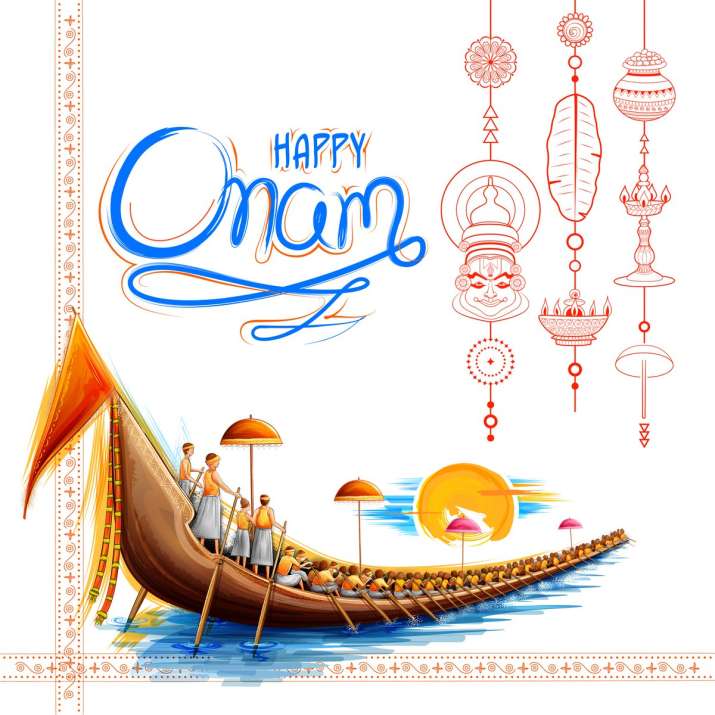
Onam is a major annual event for Malayali people in and outside Kerala. It is a harvest festival, one of three major annual Hindu celebrations along with Vishu and Thiruvathira, and it is observed with numerous festivities.[10] Onam celebrations include Vallam Kali (boat races), Pulikali (tiger dances), Pookkalam (flower arrangement), Onathappan (worship), Onam Kali, Tug of War, Thumbi Thullal (women's dance), Kummattikali (mask dance), Onathallu (martial arts), Onavillu (music), Kazhchakkula (plantain offerings), Onapottan (costumes), Atthachamayam (folk songs and dance), and other celebrations.[11]
Onam is the official state festival of Kerala with public holidays that start four days from Uthradom (Onam eve).[12]. Major festivities take places across 30 venues in Thiruvananthapuram[13], capital of Kerala. It is also celebrated by Malayali diaspora around the world.[9] Though a Hindu festival, non-Hindu communities of Kerala participate in Onam celebrations considering it as a cultural festival.[9][14][12]
Mahabali legend
According to the Hindu mythology, Mahabali was the great- great-grandson of a Brahmin sage named Kashyapa, the great-grandson of demonic dictator, Hiranyakashipu, and the grandson of Vishnu devotee Prahlada. This links the festival to the Puranic mythology of Prahlada of Holika fame in Hinduism, who was the son of Hiranyakashipu. Prahlada, despite being born to a demonic Asura father who hated Vishnu, rebelled against his father's persecution of people and worshipped Vishnu. Hiranyakashipu tries to kill his son Prahlada, but is slain by Vishnu in his Narasimha avatar, Prahlada is saved.[15]

Prahlada's grandson, Mahabali, came to power by defeating the gods (Devas) and taking over the three worlds. According to Vaishnavism mythology, the defeated Devas approached Vishnu for help in their battle with Mahabali.[8] Vishnu refused to join the gods in violence against Mahabali, because Mahabali was a good ruler and his own devotee. He, instead, decided to test Mahabali's devotion at an opportune moment. Mahabali, after his victory over the gods, declared that he would perform a Yajna (homa sacrifices/rituals) and grant anyone any request during the Yajna. Vishnu took the avatar of a dwarf boy called Vamana and approached Mahabali. The king offered anything to the boy – gold, cows, elephants, villages, food, whatever he wished. The boy said that one must not seek more than one needs, and all he needed was "three paces of land." Mahabali agreed.[8][16]
Vamana grew to an enormous size, and covered everything Mahabali ruled over in just two paces. For the third pace, Mahabali offered his head for Vishnu to step on, an act that Vishnu accepted as evidence of Mahabali's devotion.[8] Vishnu granted him a boon, by which Mahabali could visit again, once every year, the lands and people he previously ruled. This revisit marks the festival of Onam, as a reminder of the virtuous rule and his humility in keeping his promise before Vishnu. The last day of Mahabali's stay is remembered with a nine-course vegetarian Onasadya feast.[8][17]
According to Nanditha Krishna, a simpler form of this legend, one without Mahabali, is found in the Rigveda and the Vedic text Shatapatha Brahmana where a solar deity is described with powers of Vishnu. This story likely grew over time, and is in part allegorical, where Bali is a metaphor for thanksgiving offering after a bounty of rice harvest during monsoon, and Vishnu is the metaphor of the Kerala sun and summer that precedes the Onam.[18] According to Roshen Dalal, the story of Mahabali is important to Onam in Kerala, but similar Mahabali legends are significant in the region of Balia and Bawan in Uttar Pradesh, Bharuch in Gujarat, and Mahabaleshwar in Maharashtra. The story is significant not because Mahabali's rule ended, but it emphasizes the Hindu belief in cyclical nature of events, that no individual, no ruler and nothing lasts forever, except the virtues and self-understanding that overcomes all sorrow.[19]
Parashurama legend
An alternate legend behind Onam relates to Parashurama, an incarnation of Vishnu who is credited in Hindu mythology to have created the Western Ghats from the southern tip of Kerala, Karnataka, Goa and up to Maharashtra.[20] According to this legend, Vishnu got upset with the kings and the warrior caste who were constantly at war and were arrogant over others.[20]
Vishnu took the avatar of Parashurama, or "Rama with an axe" and also known as Rama Jamadagyna, in the era of King Kaartavirya. This king persecuted and oppressed the people, the sages and the gods.[20] One day, the king came to the hermitage of Parashurama and his mother Renuka, where while Parashurama was away, the king without permission took away the calf of their cow. When Parashurama returned, he felt the injustice of the king, called him to war, and killed the king and all his oppressive warriors. At the end, he threw the axe, and wherever it fell, the sea retreated, creating the land of Kerala and other coastal western parts of Indian subcontinent.[20] Another version states that Parashurama brought Namboodiri Brahmins to southwestern parts of India, by creating a mini-Himalaya-like mountain range with his axe. The Onam festival, according to this legend, celebrates Parashurama's creation of Kerala by marking those days as the new year.[21]
The legend and worship of Parashurama is attested in texts and epigraphs dated to about the 2nd
century CE


